02
Brainmets

AI-powered brain scan analysis helping radiologists identify critical conditions 40% faster
Client
Client
Brainmets
Brainmets
Type
Type
AI Healthcare · Product Design
AI Healthcare · Product Design
Role
Role
Lead Product Designer
Lead Product Designer
Year
Year
2024
2024
The challenge
The challenge
Radiologists analyzing brain scans for metastases face intense time pressure and cognitive load. They review 50-100 complex scans daily, each requiring careful examination of hundreds of brain slices. Missing a small metastasis can delay critical treatment. Current tools lack intelligent assistance, forcing radiologists to rely purely on visual pattern recognition for hours at a time.
40%
Reduction in scan analysis time.
95%
AI confidence score for detections
3-5x
Faster anomaly detection
Research & findings
Research & findings
Pattern Recognition Fatigue
Pattern Recognition Fatigue
After reviewing 30+ scans, detection accuracy drops significantly. Radiologists need intelligent highlighting to maintain focus on high-risk areas.
After reviewing 30+ scans, detection accuracy drops significantly. Radiologists need intelligent highlighting to maintain focus on high-risk areas.
Time Is Critical
Time Is Critical
Brain metastases can grow rapidly. Every hour of delayed diagnosis matters. Tools that save even 5-10 minutes per scan create meaningful patient impact.
Brain metastases can grow rapidly. Every hour of delayed diagnosis matters. Tools that save even 5-10 minutes per scan create meaningful patient impact.
Comparison Is Key
Comparison Is Key
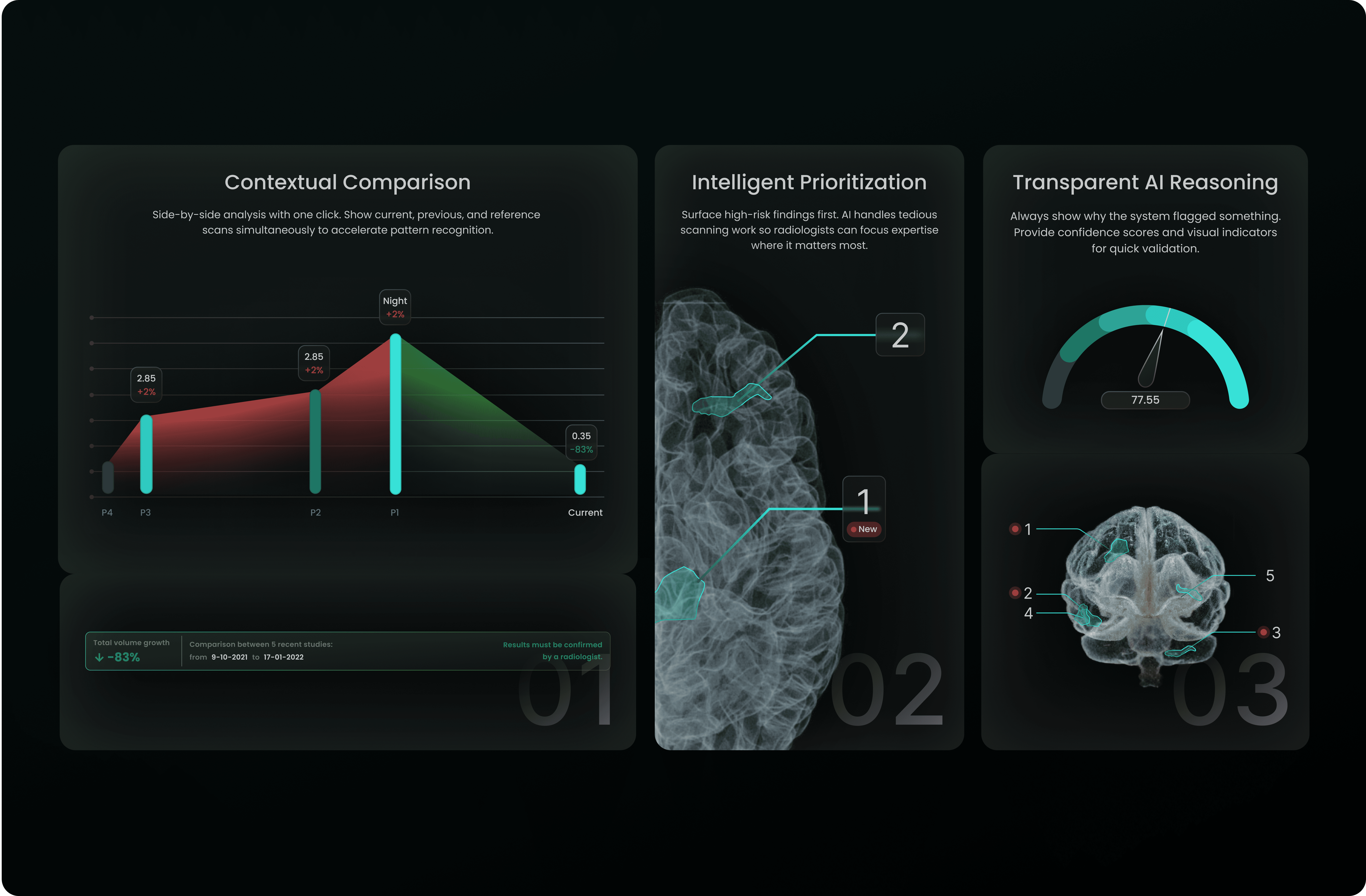
Radiologists constantly compare current scans with previous ones and with "normal" references. Sequential viewing is slow and error-prone.
Radiologists constantly compare current scans with previous ones and with "normal" references. Sequential viewing is slow and error-prone.
Trust Requires Transparency
Trust Requires Transparency
AI suggestions are only useful if radiologists understand why the system flagged something. Black-box recommendations get ignored.
AI suggestions are only useful if radiologists understand why the system flagged something. Black-box recommendations get ignored.


Design Principles
Design Principles
The Solution
The Solution
A unified workspace that combines AI-powered detection with radiologist expertise, designed for speed and accuracy.
The interface balances three critical workflows: intelligent triage for high-level scan review, deep analysis with AI-assisted detection, and side-by-side temporal comparison. Each mode reduces cognitive load while maintaining diagnostic precision.

Accessibility & Inclusive Design
Accessibility & Inclusive Design
8% of men and 0.5% of women have color vision deficiency. The design was validated against color blind simulations, ensuring critical information never relies on color alone.
All risk indicators combine color, icons, and text labels. The interface supports multiple contrast modes for different lighting conditions in medical imaging suites.


Key Learnings
Key Learnings
This project emphasized that AI transparency builds trust by ensuring radiologists understand, rather than just receive, recommendations. In high-stakes medical settings, seamless workflow integration is essential to avoid friction. While medical complexity can't be eliminated, it can be managed through progressive disclosure by keeping things simple by default with deeper details accessible when needed.
This project emphasized that AI transparency builds trust by ensuring radiologists understand, rather than just receive, recommendations. In high-stakes medical settings, seamless workflow integration is essential to avoid friction. While medical complexity can't be eliminated, it can be managed through progressive disclosure by keeping things simple by default with deeper details accessible when needed.


